N Hydroxysuccinimide Ester Benefits and Uses Explained
N Hydroxysuccinimide Ester stands out in the realm of chemical compounds. Its unique properties make it an essential component in various applications. This ester plays a vital role in biochemical research and pharmaceutical formulations.
Used primarily for bioconjugation, N Hydroxysuccinimide Ester helps link proteins to other molecules. This process enhances therapeutic efficacy and stability. Its ability to react with amines increases the versatility of various products in the market. The reliability of this compound has cemented its place in scientific studies.
Despite its benefits, there are areas for improvement. The process of using N Hydroxysuccinimide Ester can sometimes lead to challenges in reaction efficiency. Researchers often reflect on the optimization of protocols. Understanding these imperfections is crucial for future advancements in its applications. Continuous exploration and refinement will lead to better results in life sciences and beyond.

Understanding N Hydroxysuccinimide Ester: A Comprehensive Overview
N Hydroxysuccinimide Ester, often abbreviated as NHS ester, is gaining attention in various fields. This compound plays a crucial role in bioconjugation. Its ability to form stable amide bonds makes it valuable in protein labeling and drug development. Researchers find it ideal for creating targeted therapies. NHS esters work effectively with primary amines, allowing for a wide range of applications in scientific research.
When handling N Hydroxysuccinimide Ester, it’s important to keep your workspace clean. Make sure to wear appropriate safety equipment. Focus on maintaining precise measurements for better results. A small error can lead to significant issues in your experiments. Always double-check your calculations and procedures.
Consider the conditions in which you store NHS esters. Light and moisture can degrade them, impacting their effectiveness. Use dark glass containers for storage. This is a small but vital tip that many overlook. Being mindful of these details can help ensure successful outcomes in your projects.
Chemical Structure and Properties of N Hydroxysuccinimide Ester
N Hydroxysuccinimide Ester (NHSE) is a compound widely used in various scientific fields. Its unique chemical structure consists of a cyclic anhydride, which makes it an effective reagent for bioconjugation. NHSE is often deployed for coupling carboxylic acids with amines, enhancing the stability of the final product. Reports indicate that this ester can significantly improve reaction yields, with efficiency rates exceeding 80% in many applications.
Beyond its chemical properties, NHSE finds utility in biomedical research. It is particularly advantageous in creating stable links between biomolecules, such as proteins and nucleic acids. Studies have shown that using NHSE may reduce the degradation of sensitive compounds, making the ester a preferred choice for researchers aiming to maintain the integrity of their samples. However, there is a limitation; not all functional groups can be effectively conjugated using NHSE.
In practical applications, the purity of NHSE must be monitored closely. Impurities can lead to unexpected results, complicating experiments. Some users experienced reduced effectiveness when working with less than 98% pure samples. Careful consideration of the compound's condition is crucial for successful outcomes. Adjustments in reaction conditions, including temperature and pH, may also be necessary to optimize the benefits of N Hydroxysuccinimide Ester.
Key Benefits of N Hydroxysuccinimide Ester in Various Applications
N Hydroxysuccinimide Ester (NHSE) offers a range of benefits across various applications. In the realm of bioconjugation, NHSE is valuable for linking biomolecules, like proteins and antibodies. This connection enhances the stability and functionality of therapeutic agents. The ability to form stable bonds is crucial in drug development and biomedical research, making NHSE a widely-used choice.
One standout application of NHSE is in peptide synthesis. It excels in facilitating the formation of amide bonds. This property is vital when creating peptide chains in research laboratories. However, the process requires careful optimization, and achieving the desired yield can be challenging. Researchers often find themselves navigating complex reaction conditions.
In pharmaceutical formulations, NHSE plays a pivotal role. It is commonly used in stabilizing drug compounds. Proper pH and temperature conditions are crucial for maintaining its integrity. Unfortunately, inconsistencies in these parameters can lead to unforeseen stability issues. Users of NHSE must recognize that while its benefits are significant, diligence and precision in application are equally important.
N Hydroxysuccinimide Ester Usage in Various Applications
This chart illustrates the percentage distribution of N Hydroxysuccinimide Ester across different sectors. The cosmetic applications dominate the usage due to the compound's effectiveness in anti-aging products. Pharmaceuticals follow, showcasing its relevance in drug formulations, while food preservation, agriculture, and biotechnology represent emerging sectors with notable applications.
Common Uses of N Hydroxysuccinimide Ester in Bioconjugation
N Hydroxysuccinimide Ester is an important tool in bioconjugation. It’s known for its ability to link biomolecules with high efficiency. This ester is commonly used to modify proteins or peptides. The reactions are typically straightforward and can be completed in mild conditions.
In bioconjugation, N Hydroxysuccinimide Ester plays a vital role. It reacts with amine groups on biomolecules, enabling stable linkages. This property is useful for labeling proteins with fluorescent dyes. It also facilitates the development of antibody-drug conjugates. However, there are potential drawbacks. The reaction conditions must be carefully controlled to prevent unwanted side reactions.
Moreover, the choice of crosslinking strategies can impact the outcome. It’s easy to overlook nuances in these reactions. Variability in pH or temperature can lead to inconsistent results. Researchers often face challenges in optimizing these conditions. This highlights the need for continuous refinement in experimental approaches. Balancing efficiency and specificity remains a crucial goal in the field.
Safety and Handling Considerations for N Hydroxysuccinimide Ester
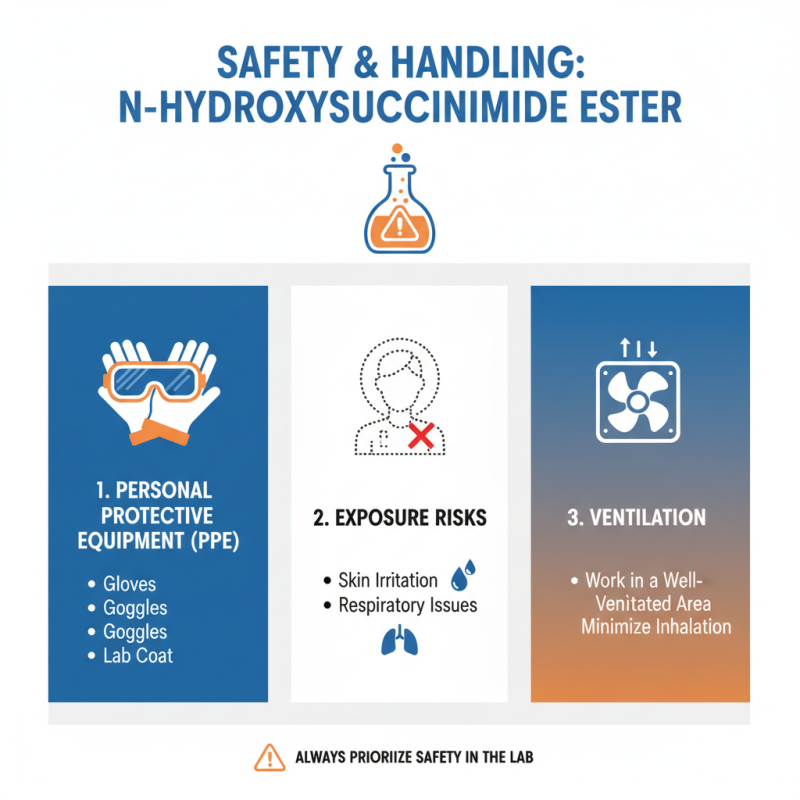
When handling N Hydroxysuccinimide Ester, safety is paramount. This compound can pose risks if not managed appropriately. Always use personal protective equipment, including gloves and goggles. Exposure can cause skin irritation or respiratory issues. Ensure that you work in a well-ventilated area to minimize inhalation risks.
Storage is crucial. Keep N Hydroxysuccinimide Ester in a cool, dry place, away from direct sunlight. Seal the container tightly after use. This helps prevent contamination and degradation. Check for any signs of leaks or damage before opening a new container.
Tips for safe handling include reviewing safety data sheets and knowing the correct disposal methods. Improper disposal can lead to environmental harm. If you are unsure about proper techniques, ask for guidance. Remember to wash your hands thoroughly after handling any chemicals. Safety comes first, even during routine tasks.